

FOSTERING EMPATHY FOR STUDENTS: GOATS IN TREES & ETHICAL DILEMMAS
(A version of this article was published in Intrepid Ed News Jul 27, 2023 as ‘Fostering Empathy for Students: Goats in Trees and Escaping Honey Badgers’).
Photos of Moroccan tree-climbing goats on social media are an amusing and fantastical image. Finding out that this amusing story has a darker side raises ethical issues. Due to the worst drought in decades together with increased temperatures, farmers dealing with crop failure were forced to give up farming and trained their goats to stand in trees for three to four hours at a time in order to get tips from tourists to feed their families. However, when the Covid pandemic swept the world, tourism stopped.
Asma Kamili, head of the Moroccan Animal Health Division for the World Organization for Animal Health explained the behavior is natural and the goats do sometimes climb Argan trees. The fruit is nutritious and the goats disperse the seeds so there are more trees; a good result all around. Ecologist Jose Fedriani from the Desertification Research Centre (CIDE) Valencia, Spain, who studies environmental degradation, says due to drought the goats aren’t just eating the fruit but also eating the leaves and seedlings so this actually prevents tree rejuvenation. Animal welfare advocates from World Animal Protection (a global nonprofit) believe that the goats are being exploited as they are forced to stay in trees for hours without water, food, or shade. Local farmers feel they have no option as the drought has made farming wheat impossible and goat tourism is the only way to create an income in this parched land. This is an ethical dilemma that is very difficult as whichever decision you make, others are badly affected. Do you feel empathy for the goats made to stand in trees or the farmers who have lost their ability to farm food and feed their families?
When considering issues of empathy in relation to other creatures with students, we can keep in mind what recent research shows us about their levels of sentience. In a recent National Geographic article, Yudhijit Bhattacharjee comments that “A necessary feature of emotional intelligence—including the capacity to respond to a fellow creature’s distress—is the ability to read the emotional state of others”. A study by Psychologist Leanne Proops conducted on 48 horses suggests that horses may be able to interpret and respond to the emotions of humans as well as other horses.
Apart from empathy towards animals, we can also consider the world of plants. In ‘The Lighteaters: How the New Science of Plant Intelligence Expands Our View of Life on Earth’, Zoë Schlanger presents a range of perspectives on plant communication.
Apart from empathy towards animals, we can also consider the world of plants. In ‘The Lighteaters: How the New Science of Plant Intelligence Expands Our View of Life on Earth’, Zoë Schlanger presents a range of perspectives on plant communication. For example, the author refers to research by Rick Karban showing “…how chemicals wafting off sagebrush can be interpreted even by wild tobacco, and how that same wild tobacco, when it begins to be damaged, can summon predators to eat the caterpillars that feed on it.”
Another example is the work of Finnish evolutionary ecologist Aino Kalske, Japanese chemical ecologist Kaori Shiojuri and Cornell chemical ecologist André Kessler. They found a difference in the chemical alarms issued by goldenrods living in peaceful or hostile areas. In peaceful areas, the alarms were sent only to biological kin, while in hostile areas, the alarms were sent to all the local goldenrod plants.
What Can We Do in the Classroom?
Many animal videos on social media are serialized, AI generated, anthropomorphise animals and show them having conversations or interviews with their “humans.” However, these interactions may not generate self-reflection. One way of developing greater student awareness about their feelings or attitudes is to use ethical dilemmas together with using our Harbord & Khan Visual Thinking Tools.
For example, we can explore the ethical dilemma “Given the latest research about plant intelligence, should humans have empathy for plants in the same way as animals or should they ignore the data?” using The Circle Toolⓒ.
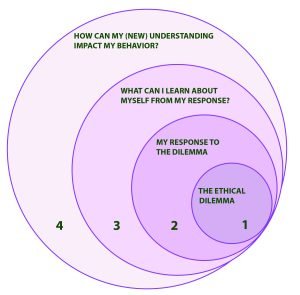
2 My Response to the Dilemma I have always felt drawn to plants and trees but tried not to think too much about how human behaviour may impact them. There are very diverse ways in which cultures treat living things. As we learn more about plant communication and intelligence, it raises questions about how we grow and harvest plants, but we still need to consume them.
3 What Can I Learn about Myself from this Response? I have some level of empathy and awareness but am also thinking in a logical way about the human body’s need to eat.
4 How Can My New Understanding Impact My Behaviour? I can be more intentional in how I take care of plants in my home. Reading the book ‘The Lighteaters’ is a start in my becoming more aware about the issue.
Will we develop greater empathy in our students by approaching the living world through a humbler and deeper understanding? By recognizing the commonalities we share with other creatures, shall our students have greater humility and value these relationships with our world? Another question worth considering is if a deeper knowledge and understanding of human behavior makes a difference in how we treat others.
References
Schlanger, Z. (2024). The light eaters : how the unseen world of plant intelligence offers a new understanding of life on Earth. Harper, an imprint of HarperCollins Publishers.
Bhattacharjee, Y. B. (2026, September 15). What are animals thinking? They feel empathy, grieve, seek joy just like us. National Geographic. Retrieved September 28, 2026, from https://www.nationalgeographic.com/magazine/article/what-are-animals-thinking-feature